

Truth be told, I read Tom Junod’s In the Days of My Youth I Was Told What It Means to Be a Man (2026) a while ago. You need to let this memoir—wildly ambitious, open-hearted, frustrating and occasionally maddening—sit for a while in order to process it.
It’s no surprise that the book can be contradictory given the figure at its center. That’s not Tom Junod, regarded as perhaps the finest magazine writer of his generation. It’s his father, Lou, one of those larger-than-life presences who dominates every room he enters, routinely gets mistaken for a celebrity, is treated like one by those in his orbit, and can’t help leaving damage in his wake. Big Lou Junod is a sun worshipper, a Sinatra disciple, and a chronic womanizer. Above all, he’s a man with ideas on how men should be and how life is meant to be lived. And Tom Junod will be shaped by them, in ways he’s still trying to fathom.
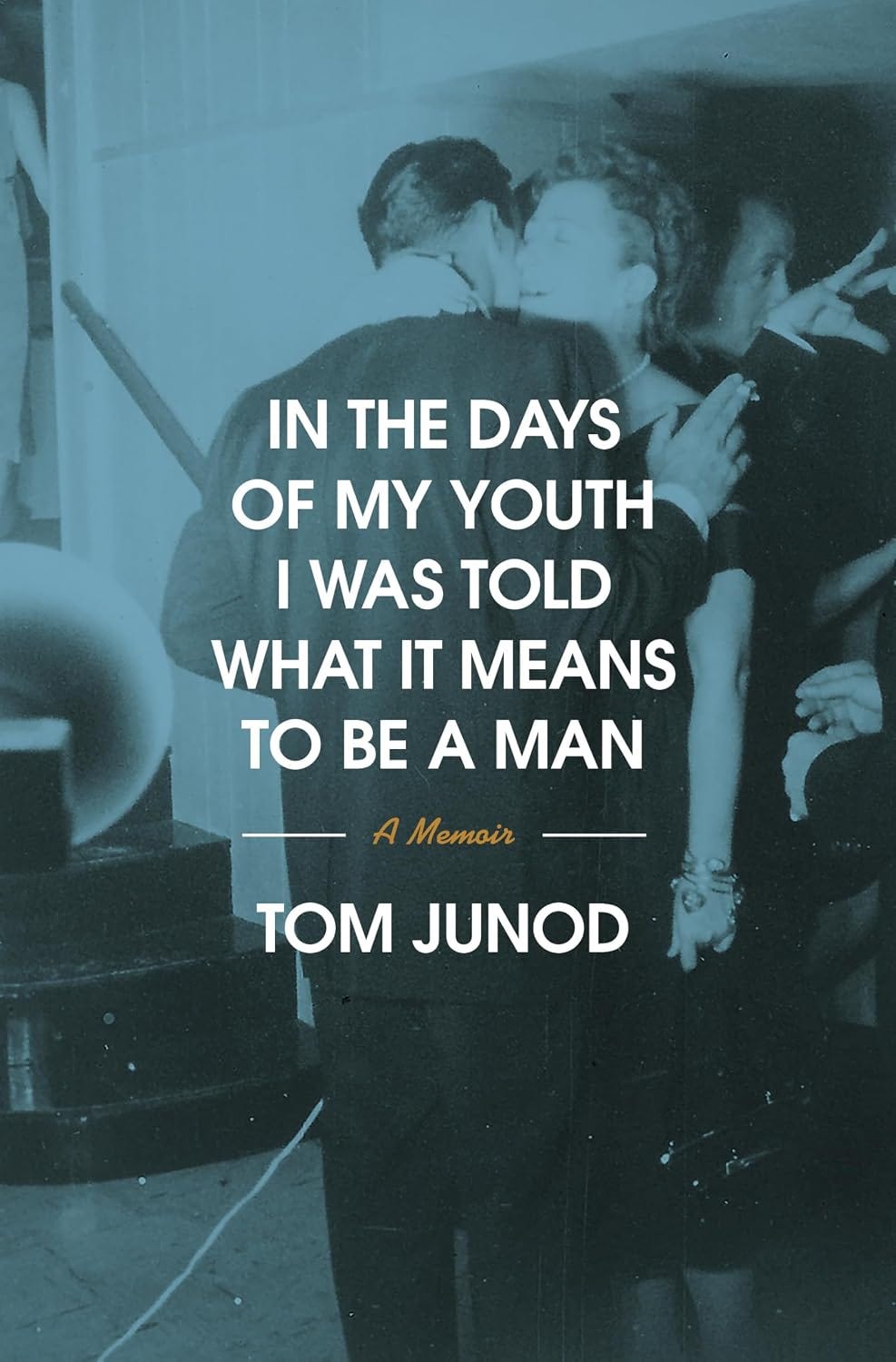
The book’s lengthy first section chronicles Tom’s youth and adolescence, when he’s being forged in the crucible of Lou’s influence. At that age, the adult world is remote and mysterious, ruled by codes you’re still struggling to comprehend. Big Lou was not the best guide to its rituals. As Junod writes:
I always suspected that he was something of a rogue, but the glamour he cultivated made me think he was a rogue like David Niven was a rogue, like Richard Burton was a rogue, like Cary Grant was a rogue, a charming thief who stole only from other dishonest men.
Cracks slowly appear in his father’s façade. Tom starts to revile “how he talks about his supposed friends behind their backs, ranking them against the punishing standard of his own exalted masculinity.” He and his family—including Lou’s wife and Tom’s mother, Fran—come to the realization that “we belong to him. That he doesn’t belong to us.”
The second section, by comparison too short, covers the years when both are adults and Tom puts Lou’s life lessons, good and bad, into practice. Tom even devotes a GQ article to his father’s approach to style—“The turtleneck is the most flattering thing a man can wear”—and living. It’s also during this period that Tom writes “Can You Say … Hero?” the 1998 Esquire profile of Mr. Rogers that is Junod’s best-known piece. Fred Rogers and Tom Junod became friends after its publication, Rogers offering him a contrasting model of masculinity not defined by surfaces. Tellingly, Lou didn’t understand their bond, telling Tom he found Mr. Rogers “effeminate.” The article provided the basis for A Beautiful Day in the Neighborhood (2019), with Junod’s fictionalized stand-in portrayed by Matthew Rhys. That character is estranged from his flamboyant father, a figure even further removed from Lou. Still, Lou would accept it as his due that the old man of his thinly-veiled son is played by an Academy Award winner, although he’d undoubtedly have wardrobe notes for Chris Cooper.
The book’s closing section is the most confounding. Following Lou’s death in 2006, Tom begins investigating his father’s life in a way he couldn’t while Lou was alive; as Tom explains, “My family has stories but no history.” He unearths a family scandal never discussed but big enough to appear on the front pages of newspapers and tracks down women with whom had Lou had long-term relationships during his marriage to Fran. He discovers that his father had a type:
Did he try to save them from what awaited them or did he ensure that what awaited them devoured them? Did he fail in his attempts to rescue them or did he succeed all too well in bringing about their ruin?
Some of the skeletons that tumble out of Lou’s closet are rumors, reports of deeply disturbing behavior that are impossible to confirm (which you want Tom, the reporter, to do) and difficult to ignore, an option Tom, the son, will never have. What carries the reader past this uneasy position is Tom Junod’s supple writing, in which he lays himself bare, and the all-too-understandable impulse behind it. Everyone wonders how far the apple fell from the tree. At times, you may require exact measurements. Tom Junod continues to admire his father’s “conviction … no, certainty” and what he bequeathed him: “He taught me how to live, man—and he gave me permission to enjoy life. He might not have been a good man but he was an elemental one.” I couldn’t even tell you if I’d want to spend time in Lou Junod’s company. But I relished the opportunity to meet him here.
I assumed it was a sign of Tom Junod’s reputation that his publisher let him get away with such a baroque title. Only after reading a review did I realize, “Shit, that’s a Led Zeppelin lyric?”
We’ve all got pantheon-level artists with whom we fail to connect. Zeppelin is one of mine. For a variety of reasons, I never got into their music. I didn’t hate it; it just failed to speak to me. I’m still not sure if I’ve made it through all eight minutes of “Stairway to Heaven.”
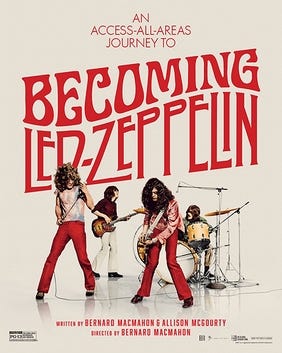
Annoyed that I’d missed the reference, I set out to school myself. Becoming Led Zeppelin (2025) is as thorough a music documentary as you’ll find. Directed by Bernard MacMahon, it was made with the band’s cooperation and features lots of uninterrupted musical performances. I’m not yet won over, though I came away with a deep respect for the band’s place in music history.
Still, when I saw footage of the clean-cut, besuited Jimmy Page and John Paul Jones as wunderkind session musicians—and learned that they’d backed up Shirley Bassey on the recording of the James Bond theme “Goldfinger” (1964)—I thought, “You had the world by the tail, lads. Was all the sex, drugs, and rock and roll really worth it?” Which is maybe the best explanation of why I never became a Led Zeppelin fan.
I can think of another reason. Zeppelin still had fans when I was in high school even though the band had long since stopped recording. The enthusiasm struck the pretentious, teenaged me as secondhand, inherited from older siblings and inauthentic. (I listened to Sinatra as well as The Police at the time, so I was one to talk.) Plus most of the Zeppelin faithful were stoners, a tribe I didn’t run with, which placed the music under a literal cloud of smoke.
Paths would occasionally cross. Erik (not his real name) wore a Zeppelin shirt almost every day. I imagined him organizing them the way Albert Einstein arranged his minimalist wardrobe, making sure he donned his Physical Graffiti T only on Thursdays. Erik was a lanky kid with an incongruously deep FM-radio voice, the kind meant to trip seismographs when saying things like “We’ve got a block of Pink Floyd coming up as we celebrate the month of Rocktober,” and he used it to torment me in the one class we had together.
In Stephen King novels, bullying is always a physical thing. Kids are forever getting chased, beaten up, stuffed into lockers. But by high school, it evolves into a more cunning psychological practice. And often a public one. I’d get to the classroom to find Erik holding forth on matters either sexual or scatological, and without fail he’d rope me into the conversation. “Vince knows about this. Right, Vince?” Or he’d invite me to tell the class about my wild weekend—“Crazy shit, man, everybody’s talking about it”—before Mr. Berger (also not his real name and counting the days until retirement) arrived to halfheartedly restore order. You could either try going toe to toe with Erik or sit in humiliated silence, with option #2 being my default choice.
I have no idea why he zeroed in on me. Maybe he sensed my unease at being in Algebra 2 again. I was retaking the class, having gotten a C in it the year before. I’d generally done well in school, but once higher mathematics was introduced it was as if I’d awoken in a world where everyone spoke Esperanto. I recognized many of the words but couldn’t follow the conversations. I’d struggled to my first-ever B-minus in Algebra 1 only to do worse in the follow-up. I was sensing the limits of my capabilities and was quietly freaking out about it.1 Not wanting to fall behind academically or socially, I retook Algebra 2 while continuing with the even harder math classes my friends were in, doubling down on the very subject that was vexing me. I thought this was how grownups responded to adversity. I’d tried the gambit before, when I started having doubts about my Catholic faith and decided, “I know what I’ll do! I’ll become an assistant CCD teacher and instruct people even younger than me about religion!” By the end of that year, I’d abandoned the church and sent a group of students into their confirmation ceremony woefully unprepared.
So there I was, flailing amidst quadratic equations while Erik insisted on vocally consulting me about a real-life medical phenomenon he called “gastric blood farts,” dreading every second I’m in that room. I eked out a B-minus and still didn’t understand algebra. I got a simultaneous C-minus in analytic geometry then flunked trig, a grade I managed to conceal from my parents.2 On the bright side, my high school was large enough that I never had to deal with Erik again.
Flash forward: I’ve graduated from college and am back in South Florida. I’m living with my parents but I’ve landed a magazine job. More importantly, I’ve met Rosemarie and we’re making plans to move west. I’m at the local mall when someone calls my name.
Erik’s voice still rumbles. He’s smiling, genuinely happy to see me. He asks how I’m doing. What I want to say is:
“Dude, are you fucking serious? You and I have never had a real conversation. I may hate your favorite band because of you. You made my life a living hell for fifty minutes every weekday for a solid year. And now you expect me to stand in front of Schnickel Fritz Deli and reminisce?”
But I don’t want to give him the satisfaction. Trouble is, I don’t know what to say instead. My old standby of awkward silence doesn’t seem like the move.
I’m surprised, then, when I cock my head and hear myself say: “Dunedin High, right? I’m sorry, but … I can’t remember your name.”
He looks crestfallen as he tells me what I already know, adding that we were in Berger’s class together. I tell him I still hate algebra, then say I’m running late to meet my girlfriend but it was good seeing him.
Was that the most mature response? Probably not. But decades later, I’m still glad I went with it.
After watching the Zeppelin documentary, I looked Erik up. He teaches martial arts in Southern California. So now I do want to talk to him.
What I’m Watching
The newsletter’s called Cocktails and Crime. I suppose I should provide one or the other.
The Samurai and the Prisoner (2026) should not work. A historical epic that’s also a series of impossible crime stories? It’s like Throne of Blood (1957) as told by Nero Wolfe, only the armchair detective is manacled in a dungeon. Kiyoshi Kurosawa, best known for horror films like Cure (1997) and Pulse (2001), adapts the novel by Honobu Yonezawa. The ingenious structure builds to a shattering late speech. Definitely worth seeing in the theater, so you can surrender fully to its spell.
I maintain that if I’d known about sabermetrics, the advanced baseball statistics then being developed, I’d have aced these classes, because the math would have had some purpose.
But not everybody. In college I had a work-study job in the dean’s office and used my access to pull my academic record. Written in red inside the folder: Failed Trigonometry. That stuff really does follow you around.
The samurai mystery movie was so nakedly directed to my tastes, I thought it might have been made specifically for me. The only thing that could have added is… maybe some taco recipes? I’m glad someone else enjoyed it.
So glad you gave "Erik" a little sass. (Dude clearly deserved it.) And like you, I failed to connect with Led Zeppelin for mots of my adult life... and despite my father being a huge fan. Then, about three years ago, I gave them another chance... and you know what? I finally got it. And it was cool to have a new catalogue of music to obsess over.