

Highest 2 Lowest. Before seeing the latest Spike Lee joint, I did my due diligence. After revisiting Akira Kurosawa’s High and Low (1963) in its new 4K restoration, I reread Ed McBain’s novel King’s Ransom (1959).1 Lee’s movie acknowledges both.
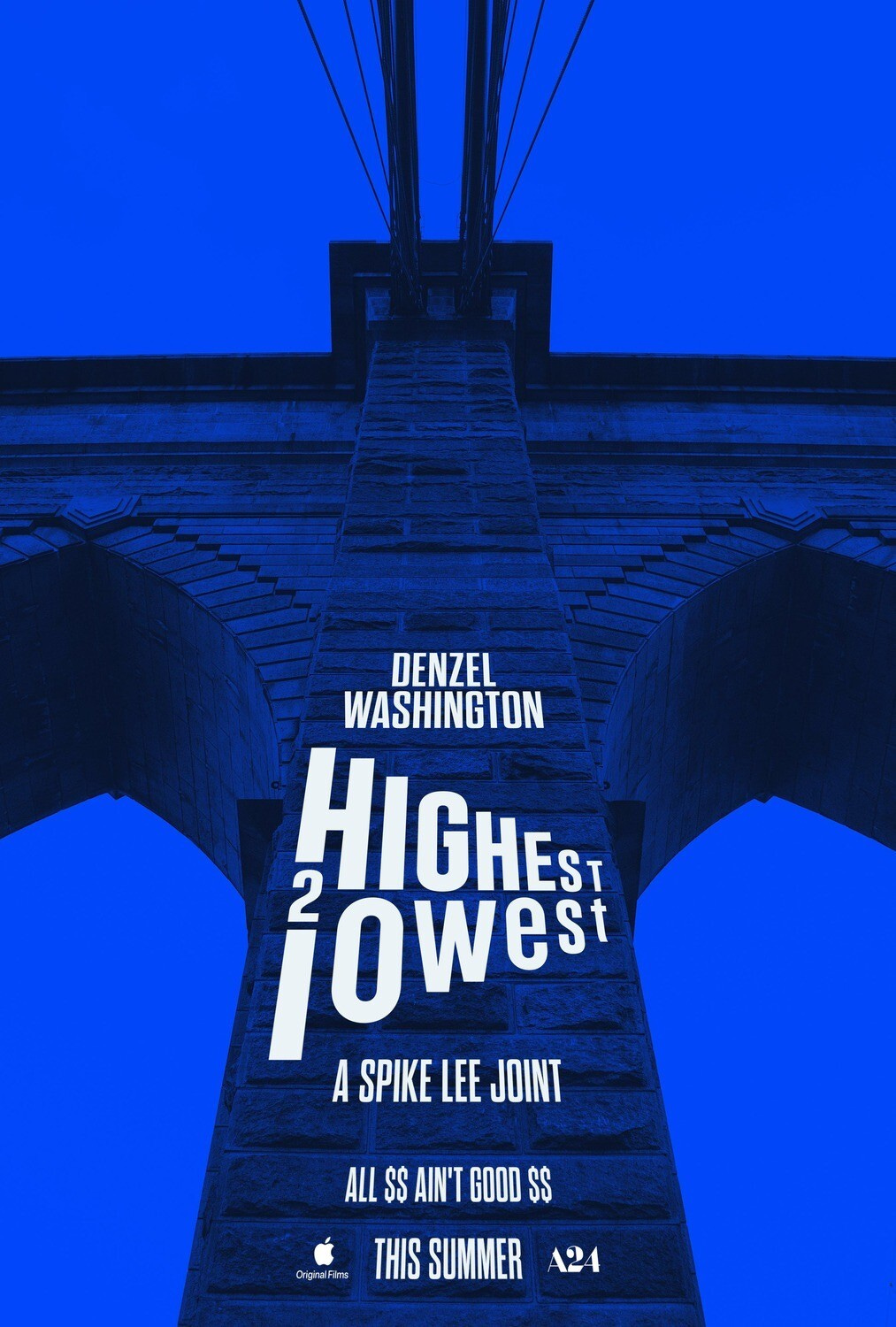
H2L plants itself firmly in the front rank of New York City movies from the title sequence, a dizzying, glorious panorama of Manhattan as seen from Brooklyn set to “Oh, What a Beautiful Mornin’” from Oklahoma! The song underscores the heights from which mogul David King (Denzel Washington) is about to fall. On this beautiful morning, he will go from closing a backroom deal enabling him to purchase the company he started two decades ago to learning his son Trey has been abducted. Lee keeps the Big Apple energy boiling during the bravura ransom drop scene, which mainly takes place on the 4 train as it rumbles its way up to the Bronx. Some may scoff at the likelihood of the Yankees playing an afternoon game during the Puerto Rican Day parade, but all New Yorkers will say, “Sounds about right. Thanks, Mayor Adams.”
The movie keeps the core plot twist—by mistake, the kidnapper has grabbed Trey’s best friend, the son of his father’s chauffeur, but still demands King pay the ransom—while updating the story in other ways. King isn’t trying to take over a shoe manufacturer but a record label, a savvy change as we’ve moved from gray flannel suit capitalism to an era of personalities capturing eyeballs; as King constantly says, attention is the only currency that matters.2 The script by Alan Fox abandons the procedural structure, leaving the work of tracking down the kidnapper to King and his chauffeur Paul Christopher (Jeffrey Wright). The police are kept at a remove both narratively and psychologically. The detectives assigned to the case treat King guardedly while regarding Christopher, an ex-convict, as a potential suspect.3 Lee tellingly shoots a scene in which two uniformed officers interview Rick Fox, playing himself as Trey’s basketball coach, so that the cops tower over the former NBA player.
Some of the alterations blunt suspense. Having King and his chauffeur be lifelong friends is an intriguing gambit. In the McBain and Kurosawa versions, King regards the man as nothing more than an employee, which makes it believable that he’d consider not paying the ransom in order to save his business. Removing that distance between the men in favor of a shared history sets up complications that the movie never fully exploits. Or maybe I just wanted to see Washington and Wright, two heavyweights, go toe to toe more. And the means by which King tumbles to the kidnapper’s identity comes together a few beats too quickly.
The appearance of the kidnapper in the form of A$AP Rocky gives H2L a third-act jolt. It’s a joy as always to watch Washington, who wears the mantle of authority with breathtaking ease. His character is aptly named, carrying himself like a monarch. When Wright’s Christopher implores King to save his son, Washington plays their dialogue with his eyes closed, in part to spare himself having to look at his friend in agony but mainly because King believes the only conversation that matters is the one he’s having with himself.
Spike Lee is incapable of making a boring movie. Highest 2 Lowest is no exception. It’s worth seeing in the theater before it drops on Apple TV+ on September 5 for the New York scenes alone.
Night Always Comes. I’ve written about the impression that Willy Vlautin’s 2021 noir novel The Night Always Comes made on me; it’s one of the few books of the past decade that I’ve read more than once. A 250-page panic attack, it tracks Lynette as she’s propelled out into the night in a last-chance bid to scrounge up the down payment on a house for herself and her family.
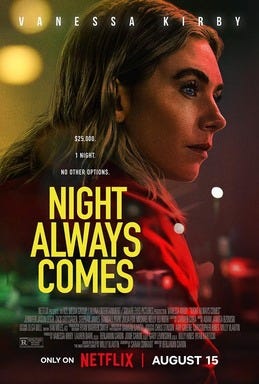
The Netflix adaptation is a worthy one.4 The film can’t hope to recreate the sense of precarity that permeates the book. It overcompensates early with a barrage of TV and radio reports on dire economic conditions, as if people teetering on the margins need to be reminded of their status. But once Lynette (Vanessa Kirby) heads out the door, a grim momentum takes hold. The cast is first-rate. Kirby lets us see Lynette fighting to hold herself together every second, hinting at a past that the movie slowly reveals. Julia Fox has a terrific scene as Lynette’s friend who has clawed her way to stability, still willing to tell Lynette mid-conversation, “You smell terrible.” Zack Gottsagen shines as Lynette’s developmentally disabled older brother. Every Jennifer Jason Leigh movie needs more Jennifer Jason Leigh. As Lynette’s mother, she doesn’t get the devastating speech from late in the book on the system being designed to crush people like their family and how her only goal in her remaining years is to rest at last. Her closing scenes with Kirby still pack a wallop. Portland, Oregon plays itself to good effect, with the house that Lynette is desperate to acquire particularly well cast. Perched above the interstate, it’s sturdy enough that someone could delude themselves into thinking they can improve it, and so shabby that another person would plausibly want to burn it to the ground.
Cloud. The latest film from Kiyoshi Kurosawa (Cure, Pulse, Bright Future) begins as a harrowing look at how the frictionless existence afforded by the internet now taints every human interaction. Yoshii (Masaki Suda) has a side hustle as an online reseller, manipulating people to buy items in bulk so he can jack up prices and blithely hocking counterfeit merchandise. He watches each bounty sell out with the detachment of a gambler, whatever joy he feels subsumed by the knowledge that he’s got to find his next score fast. Able to quit his day job, he moves to an isolated home in the mountains that he transforms into a warehouse, suited to packages and not people. His misdeeds begin to catch up with him, but Kurosawa sets the story in a benumbed world where revenge and even murder don’t get the blood racing. Cloud turns into a nightmare where every callous internet exchange and indifferent thought has in-your-face consequences, like a deadpan gunfight in a nondescript industrial landscape out of countless video games. The film has one more twist in store, its final scene on the nose, obscure, and deeply unsettling all at once. I’m not entirely sure what Cloud is saying. I’m not positive that the movie knows. But I haven’t stopped thinking about it.
Weapons. Zach Cregger’s latest is being sold as a horror movie, which is most definitely is. For much of its running time it’s also a compelling mystery, Cregger’s script employing a looping structure as a disparate group of people try to discover what happened to seventeen classmates who vanished from their homes at 2:17 AM. Cregger juggles a range of tones including a surprising amount of comedy, and the wild ending demands to be seen in a theater with as many people as possible.5
The novel comes across like a very special episode, in no way a knock on the book as McBain wrote what is arguably the greatest procedural series of all time. King’s Ransom was in fact adapted on the short-lived 87th Precinct TV show (1961-62), which I’ve never seen.
One could argue that the depth of that attention determines the true value of the currency, but we’re trying to make a crime movie here.
Dean Winters turns up as the most skeptical of the detectives, allowing a sly throwaway reference by Wright to Winters’ ubiquitous “Mayhem” ads for Allstate Insurance.
Where the definite article went is a mystery for another day.
Give a pay raise to whoever suggested a 2:17 start time for all the opening day matinees. Nice touch.
"Perched above the interstate, it’s sturdy enough that someone could delude themselves into thinking they can improve it, and so shabby that another person would plausibly want to burn it to the ground."
Yikes, that precisely (and very eloquently) describes MY house! LOL!
I consider my home a nice compromise between the total wreckage and unaffordable/overpriced mediocrity I waded through before I found it. And hey, I'm a hot minute from the freeway entrance!
I'm watching Kurosawa's HIGH AND LOW; it was missing from my movie viewing history. It's brilliant, as I knew it would be.
Keep up the great work, Amigo!
It has been a long time since I've seen High and Low but am I remembering correctly that an added layer in the decision to pay the ransom is that Mifune's character owes a significant debt to his wife's family for the business and she applies significant moral pressure on him to do the right thing? (so to speak : )