

Ahead of last year’s memorial for my friend and celebrated bartender Murray Stenson, I received a surprising invitation. Justin Freet, a filmmaker who had put in his share of time behind the bar, was assembling a tribute to Murray, collecting reminiscences from those who knew him. Justin had read my post about Murray’s passing and kindly asked me to participate. I had a Campari and soda at Place Pigalle—the drink and the restaurant both Murray mainstays—and shared a few of my favorite stories. The film screened at the memorial. I was honored to be a part of it.
Justin continued to work on the documentary and unveiled the final version at Liberty, the bar where he himself had worked, on July 28. I was unable to attend the premiere because I’d committed to an event showcasing chartreuse, the liqueur that Murray did so much to lionize. I didn’t feel too bad about it, because Murray would have absolutely insisted that I go where chartreuse was being poured. I ordered a glass in his memory.
“… to Murray” is now on YouTube. It’s a lovely eulogy for a man who made a huge difference in myriad small ways and is still missed.
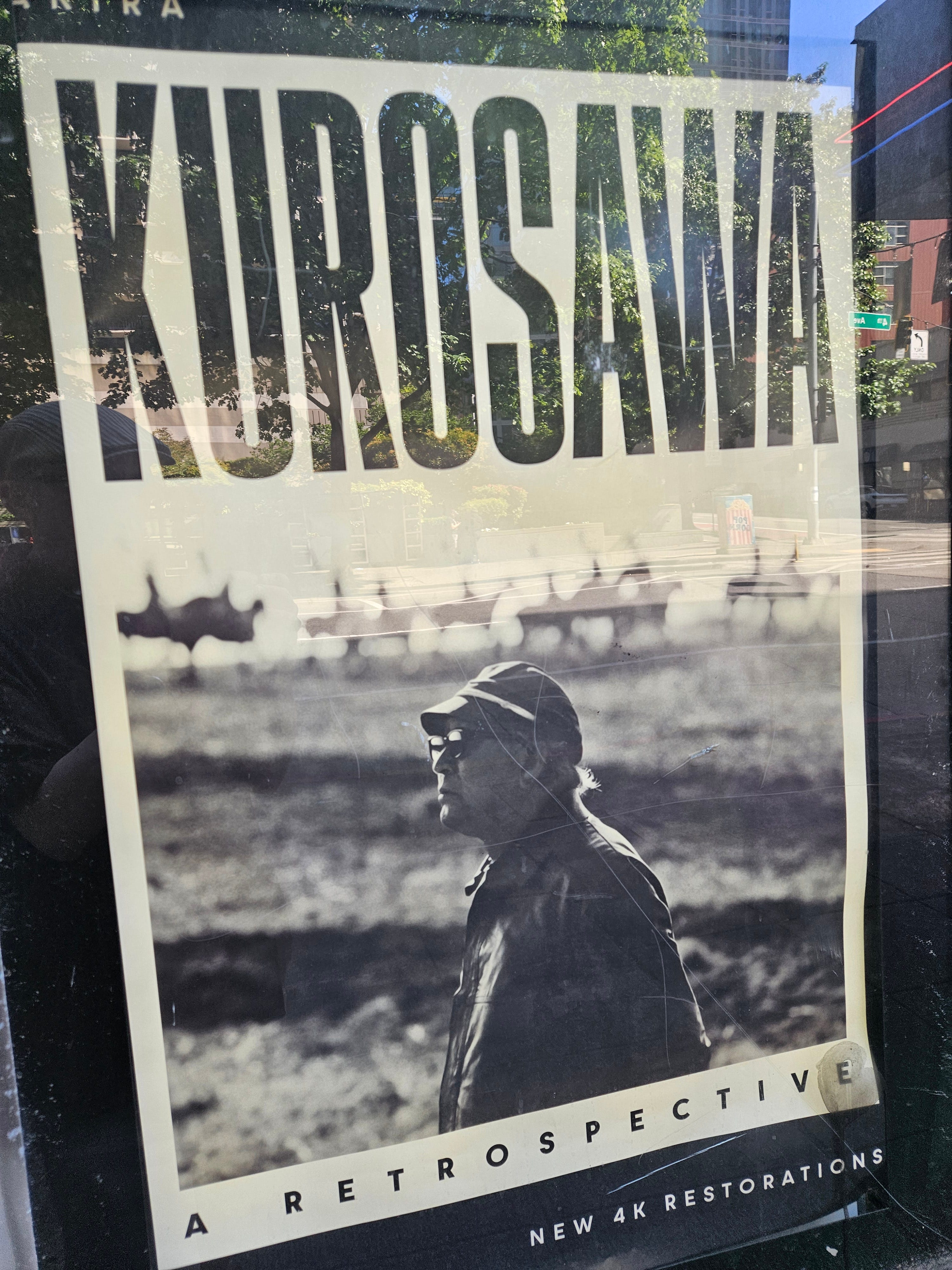
I had a birthday over last weekend. I’ve indulged myself the last few. Two years ago I took an improv class, and last year I sprang for a glass of Howard Hughes’s bourbon. (The Seattle bar The Doctor’s Office still has plenty of the Hughes booze collection on hand if you’re so inclined.) This occasion would be a more sedate affair spent in good company, that of Akira Kurosawa. SIFF Cinema is showing a retrospective of the filmmaker’s work in new 4K restorations. Seeing Ran (1985) for the first time is already a high point of 2025, so I packed my birthday weekend with three films, two that I’d deliberately saved for the big-screen treatment and an old favorite about to be reinterpreted.
The Hidden Fortress (1958) is best known today for its influence on Star Wars (1977), foregrounding two bickering peasants embroiled in a campaign by a roguish warrior (Toshiro Mifune) to deliver a princess to safety. The title redoubt is located in a landscape that certainly resembles Tatooine. The movie is really Kurosawa’s boisterous homage to John Ford, bursting with high adventure and low comedy. Still, it’s the mournful song heard at the film’s fire festival and reprised at the end, about how the lives of men and insects are similar in that they are all too brief, that will stay with me.
It was a shock to return the next day to see the vigorous Mifune transformed into a brooding killer in Throne of Blood (1957). Kurosawa’s treatment of Macbeth strips the language from the structure, but the power of Shakespeare’s play remains undimmed. The supernatural elements mesh perfectly with Kurosawa’s sweep and physicality, exemplified in Mifune’s final scene.
I’ve seen High and Low (1963) several times, but I wasn’t about to miss the 4K restoration on the eve of the release of Highest 2 Lowest (2025), Spike Lee’s take on Kurosawa’s film as well as its source novel, King’s Ransom (1959) by Ed McBain. High and Low is bifurcated, its first half practically a Playhouse 90-style drama set entirely in the hilltop home of businessman Kingo Gondo (the chameleonic Mifune again). He’s gambling his entire fortune on a risky scheme to take over the shoe manufacturer where he’s spent his career. In the midst of his maneuvering, he learns that his young son has been kidnapped. As Gondo processes the news, his son scampers into the room. A change in costume has resulted in the child of Gondo’s chauffeur being abducted instead. Gondo rejoices, believing he’s off the hook. But the kidnapper doesn’t give a damn about his mistake. He still wants his money and still expects to Gondo to pony it up. The moral dilemma is hashed out over a long, sleepless night, Gondo desperate to keep his buyout bid alive as he weighs his responsibility to another man’s offspring.
Kurosawa’s pitiless view of capitalism, planted in these scenes, comes to full, bitter blossom in the second procedural half as the police scramble to track down the kidnapping’s mastermind. Gondo’s fellow executives, indifferent to his plight, are dismissed as a “bunch of assholes” by one of the lead investigators. A reference to the oppressive heat made during one of the ransom calls establishes the simmering class rage underlying the crime. Bong Joon Ho has cited High and Low as an inspiration for Parasite (2019), the layout of Gondo’s residence subtly referenced in the architecture of the home crucial to Bong’s Oscar-winning film. That lineage came across clearly in this viewing. Also landing with force: the extended final sequence, startling now and undoubtedly shocking in the 1960s, as detectives trail the kidnapper through a seedy club for a drug buy—I wanted to slow down the action so I could read every liquor sign—followed by a harrowing jaunt to “Dope Alley.” Early reports indicate that Highest 2 Lowest jettisons both McBain’s and Kurosawa’s third acts, keeping the focus on the mogul character (Denzel Washington, maybe the only actor who could plausibly succeed Mifune; he’s already played Macbeth) and his chauffeur (Jeffrey Wright) while steeping the mayhem in rich New York atmosphere. I’ll be seeing it in the same theater where I revisited High and Low.
The Kurosawa retrospective runs at SIFF Cinema through August 14 and is currently playing in Austin, Los Angeles, and New York, with a stop in Vancouver later this year.

I still made the ceremonial trip to The Doctor’s Office, where among other delights I enjoyed a Little Pig Punch from their new menu. Bartender Chelsea Matthews concocted this drink as a nod to noted Honolulu restaurant The Pig & The Lady. It’s the rare tropical cocktail made with rye, supplemented with pandan vanilla iced tea, grapefruit, and tiki bitters. I won’t be waiting for my next birthday to have another one.
...To Murray is excellent. Thanks for the link.