

2027 marks the fiftieth anniversary of Ridley Scott’s debut feature film, The Duellists (1977). His thirty-first movie, an adaptation of Robert Louis Stevenson’s Treasure Island with Hugh Jackman as Long John Silver, is tentatively scheduled to hit theaters in November of that year. On November 30, 2027, Scott will turn ninety years old.
Sometimes the reward for a prolific, protean career is an unknowable quality. Scott has directed his share of contemporary classics and commercial successes; some of the films are one and the same. But ask critics to define a Ridley Scott movie and you’ll hear talk of the slickness of the images, a backhanded compliment nodding to his lucrative, decades-long side hustle helming commercials. Scott made his name in science fiction, had his greatest triumph with a hugely-scaled period drama, and tackled other genres in between, a facility with form that harks back to the heyday of the studio system—and another trait that renders him difficult to pin down.
The movie business being what it is today, we’re unlikely to see another Ridley Scott. His extraordinary run is worthy of acknowledgment, which I intend to do by watching all of his movies in order.1
Why, you might well ask. Because I crave structure. 2026 has been a taxing year, with its closing months promising additional stress. At such times, I give myself projects I can complete on my own timetable, to serve as both distraction and impetus. In my blogging days, for no good reason, I watched (almost) every movie where Burt Reynolds played a cop; I’m always reading a long-running mystery series (Ross Macdonald’s Lew Archer, Maj Sjöwall and Per Wahlöö’s Martin Beck, Joseph Hansen’s Dave Brandstetter) chronologically. I could use such an undertaking right about now.
Why Ridley Scott? Because he’s a first-rate craftsman with a lengthy track record who still feels underappreciated.2 Because among his formidable filmography are many movies I’ve enjoyed multiple times; several I’ve wanted to revisit; a half-dozen I’ve never seen; and a few I’d pay hard cash to avoid watching again. I’ll rewatch them anyway, in the interests of completion. Because I admire people who work at a high level for a long time.
The ground rules: I’m focusing exclusively on Scott as a director, not as a producer. The posts will be sporadic, woven in amidst other material. But they will be in chronological order, which means going back to the very beginning.
Boy and Bicycle (1965) is a family affair. The short film stars Scott’s younger brother Tony, who would go on to become a notable filmmaker himself (Top Gun [1986], True Romance [1993]), and features both of their parents. The simple, highly effective mood piece follows a teenager as he skips school to explore his hometown on the title conveyance. Virtually all of the dialogue is a stream-of-consciousness voiceover, a clever way to make a virtue out of the lack of synchronized sound. In his inner monologue, the boy routinely mocks authority figures but is also hopeful, curious, and alive to the sense of possibility as he moves through a familiar world that now feels different; it’s Scott’s sole writing credit. He pushes the identification with the boy in an early POV sequence, the boy’s gaze drifting around his bedroom as he ignores his mother’s pleas to get up. Boy and Bicycle feels like what it is: a student film made by the most talented kid in class, one with an uncanny gift for images. Scott’s producing savvy was also already in evidence. He scored the short in part with a piece by John Barry. When the film was going to be exhibited, he couldn’t afford to license the music. He contacted the composer, already famous for his work on the James Bond films, and begged for help, badgering him to the point that Barry rerecorded the piece specifically for use in Scott’s film.
Boy and Bicycle is currently streaming on Kanopy.
After graduating from the Royal College of Art, Scott was hired by the BBC as a designer. He was slated to create the look of the Daleks in their debut appearance on Doctor Who but left before he could do so to start a training program as a TV director. Scott’s take on the Daleks makes for a tantalizing what-if, but he’d have a hand in molding other iconic villains. His work on shows like the groundbreaking police drama Z-Cars is lost save for a single episode of Adam Adamant Lives! The 1966-67 series, which I’d never heard of until I started this project but would have watched religiously, was the work of several Doctor Who veterans. It recounts the exploits of an Edwardian man of action (Gerald Harper in a perfectly-pitched performance) who is frozen by his nemesis and thawed out in Swinging London. Behold the title sequence, complete with knockoff John Barry-style 007 theme, in all its mod glory.
The only extant episode of the three Scott directed, “The League of Uncharitable Ladies” (1966) prefigures the plot of the Charles Bronson dud Telefon (1977) or, if you prefer, The Naked Gun: From the Files of Police Squad! (1988). Adamant, pressed into service to investigate the mysterious deaths of several government officials, squares off against a women’s club of do-gooders willing to go to extreme lengths to achieve their agenda. The production values are typical of the BBC at the time—lots of wobbly indoor sets—but Scott gets to show what he’s made of in the opening sequence, with its bowler-hatted functionary stalked through an empty park by two young women determined to extract a donation. It nails the eerie unreality that was a hallmark of its more successful competitor series, The Avengers.
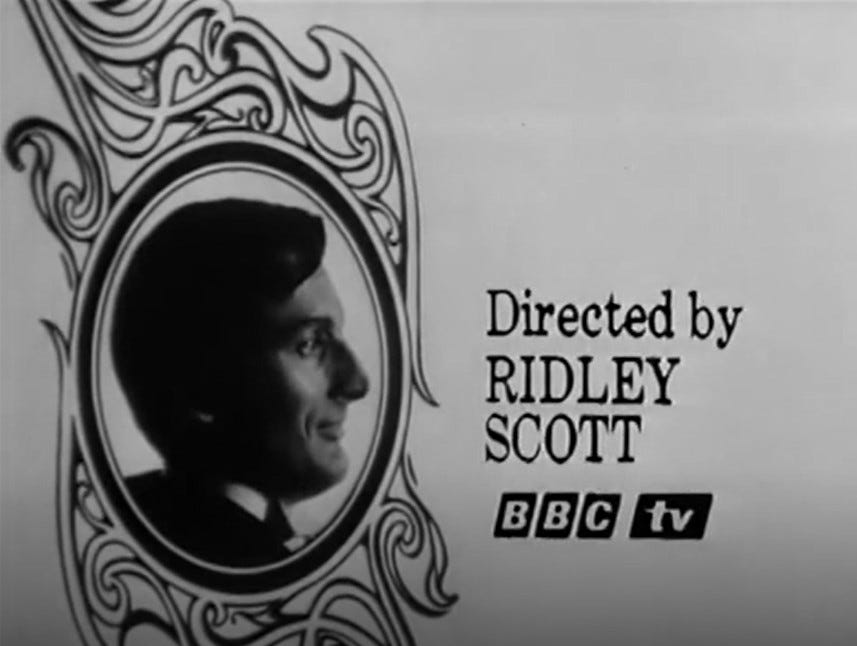
“The League of Uncharitable Ladies” is on YouTube, but a superior version is available via Internet Archive.
It was as a director of commercials that Scott truly established his chops. He was so renowned that documentaries highlighted his acumen. In one from 1969, he refers to himself as a filmmaker, not a commercial maker, and forthrightly admits that he doesn’t much care about the product being advertised. Among his credits: a 1969 advert for Lux ice cream (“with pop cards”) featuring David Bowie and the 1971 Maxwell House spot that led actor Michael Caine to track down its star. (Caine and Shakira Baksh have been married for over 50 years.) There’s also this comic caper for Benson & Hedges cigarettes with Terry-Thomas and Eric Sykes.
Scott’s reputation was made with a 1973 ad crowned the most beloved in UK history. Not only was it restored in 2019, the BFI made a short documentary about its restoration. (The finished product is at the end of the documentary.)
This storied spot for Hovis Bread is known as “The Bike Ride” or “Boy on the Bike,” Scott returning to elements of his first film; tellingly, his 1965 short opens with a milkman making his rounds much as the delivery boy does here. The ad tells a quintessentially British tale, valorizing hard work and a hot cup of tea.3 Its lessons—develop a routine, go about your business, and keep moving—would serve a body well in fifty-plus years of filmmaking. Or ninety years of life.
In the title of this series, “row” rhymes with “oh,” meaning sequentially, as opposed to “ow,” implying that Sir Ridley is in a dust-up with his mates.
Scott, who has received multiple Academy Award nominations but has never won, will receive an honorary Oscar in November 2026 for being “a true visionary whose decades-long legacy has left an immeasurable impact on global cinema.”
I don’t wanna be that guy, but I don’t entirely understand this commercial. The kid delivers bread, and for his efforts he’s rewarded with … a slice of mass-produced bread? Maybe it’s an English thing.